Staying Human in the Human + AI Stream
I recently attended the Futureproof Festival of AI, the cyborg baby of Kris Krüg and the BC + AI Ecosystem.
I went in with my favorite Mr T notebook and came out with pages of notes, scribbled while listening to speaker after speaker. At home, I dictated those notes to Claude and used AI to turn them into a visual: a river of everything I heard and the common streams that came together.
Every talk became a tributary. Every tributary joined one main river: Humans + AI. And all of it flowed toward a delta - Ben Shneiderman’s closing challenge to the room.
The River, Mapped
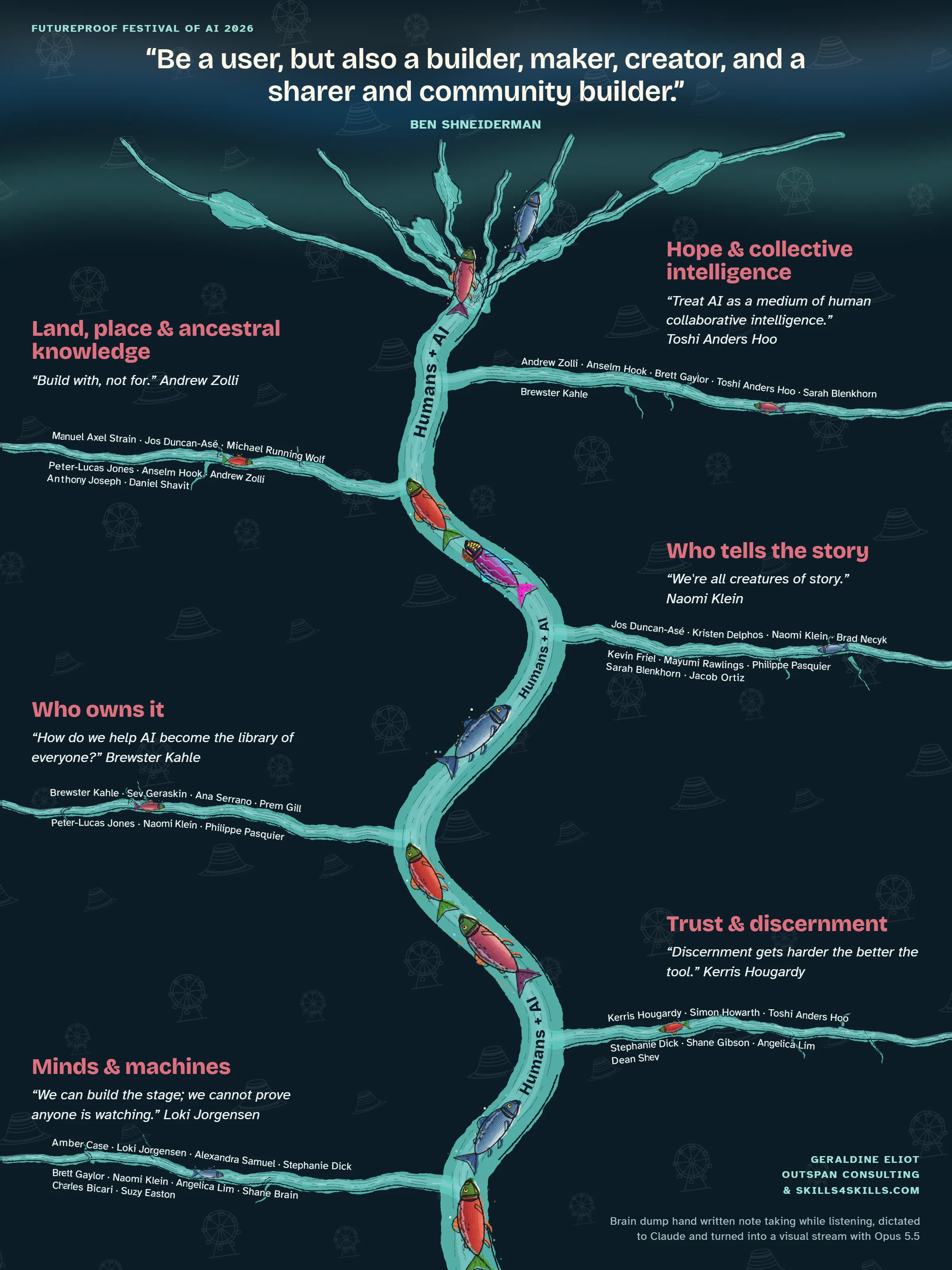
Six streams, one river, and salmon swimming upstream. The cyberpunk salmon with the pirate gold grin is for Kris.
Six Streams
When I looked back over my notes, the same currents kept surfacing, talk after talk. None of them stayed in one river bed (are Claude and I taking this metaphor too far?)
Who tells the story
Naomi Klein put it simply: “We’re all creatures of story.” Almost every speaker talked about story, and if not directly, about creativity. Jos Duncan-Asé asked who controls the stories, the news, and the voices we hear. Kristen Delphos reminded us that tools change in every age, but the storyteller hasn’t, and that “your 7-year-old self is still the one doing your best work.”
Brad Necyk gave me my favourite warning: “The sensible sentence arrives too soon.” Naomi Klein said we brush out the struggles of the creative process, the “cue cards on the wall and the crying” (which I think should be the title of her next book), and that’s where we lose something.
Who owns it
Brewster Kahle asked how we help AI become the library of everyone, not just of a few large organizations. Sev Geraskin pointed underneath that to the infrastructure: whoever owns it decides who gets access to the power, and who can turn it off. Ana Serrano and Prem Gill talked about public, federated AI that keeps human agency at the centre.
Peter-Lucas Jones showed what ownership can look like in practice. Te Hiku Media controls its own data and who has access to it.
Land, place & ancestral knowledge
Friday opened with Manuel Axel Strain sharing Indigenous stories of stone and water, and a song. Jos Duncan-Asé asked how AI impacts land and place, what came before it, and who we are designing for. Michael Running Wolf showed AI as a safe space to practise a language before speaking it with elders.
Andrew Zolli’s line stays with me: “build with, not for.”
Trust & discernment
This is the stream closest to Skills4Skills. Kerris Hougardy said it best: “Discernment gets harder the better the tool.” Output looks so good, and comes so quickly, that it’s harder to tell if it’s right. Things can be cheap to make with AI, but very expensive to be wrong. Her answer: pause, probe, prove, own.
Simon Howarth described a balance from AI drug discovery: 20% human at the start, 60% AI, then 20% human again. That missing second 20% is what Skills4Skills is working on. People do the first 20 and the 60, then nothing. Stephanie Dick added that trusting each other is a political act; maybe trusting ourselves is too?
Minds & machines
Loki Jorgensen reminded us how little we understand consciousness - ours or a machine’s: “We can build the stage; we cannot prove anyone is watching.” Amber Case argued that good tech engages our back brain and only asks for attention when it’s necessary.
Alexandra Samuel spoke up for the edges. LLMs sit in the middle of the bell curve, and people need room to work the way they’re wired. And Naomi Klein left me with a question I keep asking myself: “Am I becoming more or less human, or am I cognitively offloading?”
Hope & collective intelligence
Toshi Anders Hoo asked us to treat AI as a medium of human collaborative intelligence, not a human replacement. Andrew Zolli showed satellites and AI spotting illegal roads in the Amazon before the deforestation starts. Brett Gaylor talked about practising hope, and Sarah Blenkhorn asked us to feed AI better stories, because it becomes the stories we feed it.
Hope ran through more talks than I expected, and yes, I even cried at some points.
Where it all Flows
Ben Shneiderman closed the festival, and his talk drew the threads together. AI is a tool, not a teammate, and humans control it. Its job is to amplify, empower and enhance people.
Then came the line at the top of my map: “Be a user, but also a builder, maker, creator, and a sharer and community builder.” To make things, he said, is what makes us human. The next stage is collective intelligence, turned into collective action.
That is what staying human in the Human + AI stream means to me and what we’re working on with Skills4Skills. Pause before you trust the output. Keep your own fingerprint on the work. Bring the human back in at the end, not only at the start. And build with each other, not just with the tool.
This is not 100% me; I used AI as a tool.