AI use at work has doubled since 2023, yet an MIT Media Lab report found that 95% of organizations saw no measurable return on their AI investment (HBR). One overlooked reason: the time AI saves one team member can be spent by the next, cleaning up the result.
Researchers at Stanford and BetterUp Labs gave that problem a name: workslop.
What workslop is
Workslop is AI-generated work that looks finished but does not move the task forward. Picture a report with tidy headings and confident language that leaves out the context the reader needs or alignment with organizational goals (or even embarrassing mistakes).
The term comes from a September 2025 Harvard Business Review article by researchers at BetterUp Labs and the Stanford Social Media Lab. Their central point: the sender saves effort, and the receiver pays for it by interpreting, correcting, or redoing the work.
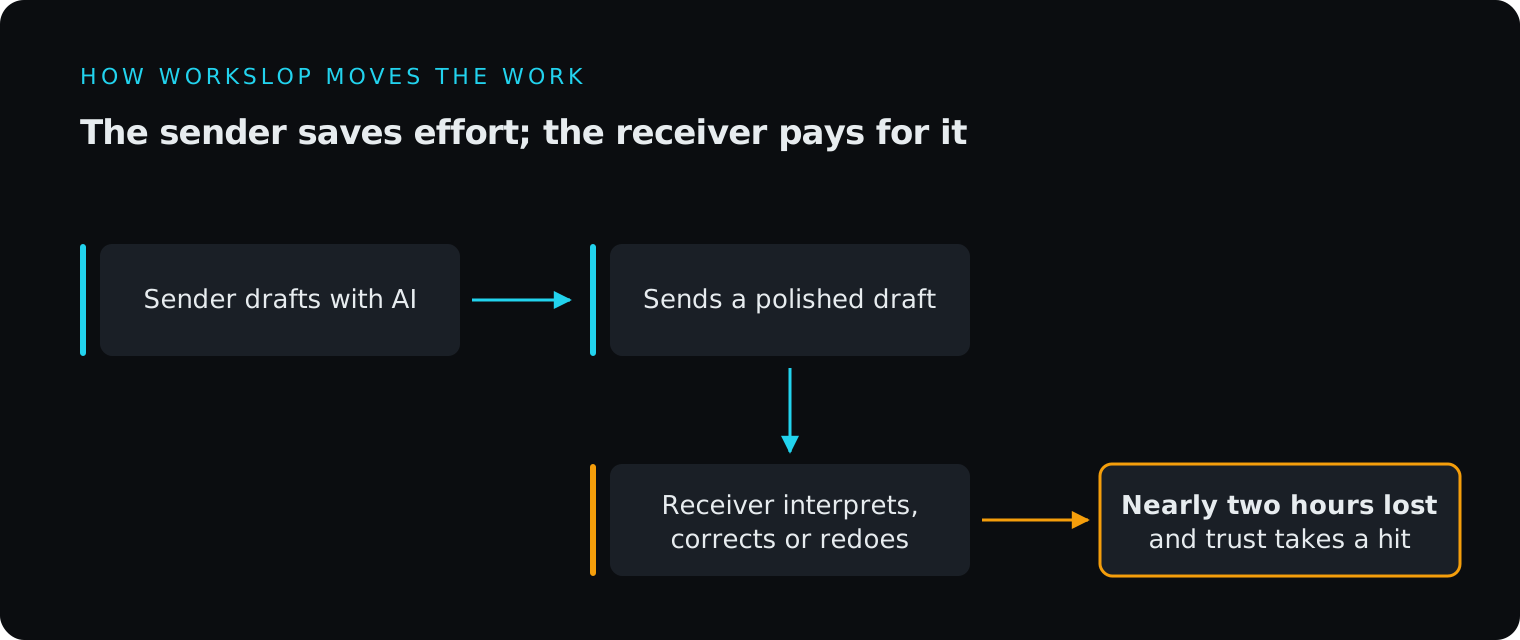
How workslop moves the work downstream: the sender drafts with AI and sends a polished draft, then the receiver interprets, corrects, or redoes it, which costs nearly two hours and hurts trust.
The cost doesn’t disappear - it just moves to the reader.
What it actually costs
Each incident takes nearly two hours to fix, and it dents trust in the sender. The research is based on a survey of 1,150 full-time US employees (TechCrunch). Here is what it found:
- 41% had encountered workslop (HBR).
- Respondents estimated about 15% of the content they receive fits the description (The Hustle).
- Dealing with one incident took nearly two hours of rework (HBR).
- About half of recipients saw the sender as less creative, capable, or reliable, and 42% saw them as less trustworthy (Shelly Palmer).
- 18% of AI users admitted to sending low-quality AI content themselves (Axios).
These are self-reported survey figures, so read them as a strong signal, not an audited cost (The Next Web).
Why it happens
Workslop grows when organizations push AI use without setting a quality bar. The HBR authors point to broad mandates paired with too little guidance on quality standards (HBR).
A skills gap makes it worse. A Microsoft Research and Carnegie Mellon survey of 319 knowledge workers found that people often skip critical thinking when they lack the skills to inspect, improve, and guide AI output (Campus Technology). Telling people to use AI more, without teaching them how to check it, is a recipe for workslop.
What to do about it
The fix is not less AI; it’s clearer standards and better checking skills. Three steps for HR and L&D leaders:
- Set a quality bar. Spell out what good looks like for AI-assisted work, and hold it to the same standard as work done without AI. The HBR authors call for clear norms (HBR).
- Teach the checking skills, not just prompting. The Microsoft and Carnegie Mellon researchers recommend training in verifying information, integrating AI responses, and steering the task (Inquirer).
- Model purposeful use. HBR advises leaders to show how and why they use AI, and to treat it as a collaborative tool, not a shortcut (HBR).
A simple test for any AI-assisted draft before it is sent: would the reader be able to rely on this without redoing any of it?
Where Skills4Skills fits
Skills4Skills supports teams in keeping AI from dulling their people’s professional judgment. We start with a needs analysis to see where your team members use AI and where quality gaps show up. Then we build skills development into the AI tools they already use, so checking and judgment become part of the work.
If workslop is showing up on your team, get in touch.